It’s not very difficult to enjoy a Hockney painting, the bold colors and unlabored brushwork are immediately accessible. But I didn’t truly appreciate his output until I got to Los Angeles and was able to encounter, first hand, the magical light of Southern California. The very air here has a palpable blue quality. Especially for those who weren’t born into that air and light, the experience is mind blowing and, coming from New England, I could understand the impact it must have made on his English eyes.
As he made LA his adopted home, the City of Angels was the beneficiary of having dibs on his retrospectives and shows. So it was in LA where I fully became aware of the immensity of his portfolio: from the polariods to the opera scenic designs, from the paintings to the iPad renderings. I documented his 2018 LACMA show, “82 Portraits and 1 Still-life”, and the digitally created works from his 2025 Palm Springs Art Museum show, “Perspective Should Be Reversed” on social media. What impresses me most is his consistency of creation. He constantly interacted with the world, both natural and technological, and used it all for inspiration. In the digital work, he even offered a time-lapse of its development. Much as demonstrated in Picasso’s film “The Mystery of Picasso,” Hockney was so facile with his “marks on paper” that his images formed effortlessly. He was an artist who appeared truly happy with life.
I last saw a Hockney, his “Mulholland Drive: The Road to the Studio,” at the LACMA last week. Though seemingly stylistic, it is surprisingly accurate. I guess you can say that about all his works. I think this short clip from a Robert Hughes program gives a pretty good overview of Hockney through the early 21st century. You can even see how he will soon move into the digital from this point forward.
Friends, giants still exist.
David Hockney: 1937–2026
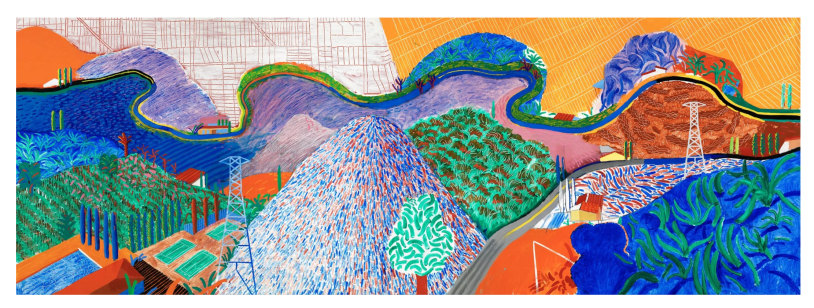
David Hockney, Mulholland Drive: The Road to the Studio (1980)


