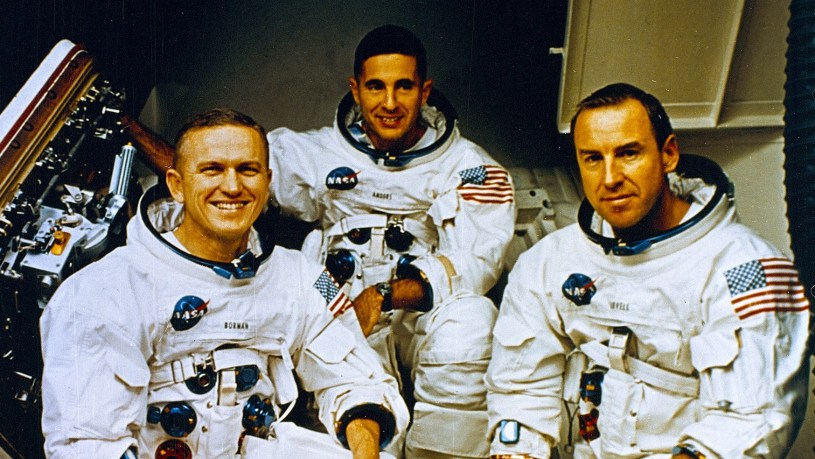
On Christmas Eve 1968, space faring humans orbited a body other than the Earth for the very first time. I tried to capture something of the Apollo 8 accomplishment in an essay on the 50th anniversary of the event. In the seven years since that piece, I’ve had more thoughts.
While people rightly remember the first landing on the Moon in July of 1969 as the peak of the space program, Apollo 8 deserves as much memory. Walking on the Moon provides its own sense of wonder, it is a physical thing and a definitive act. It swallows up the more nuanced wonder and audacity of traveling 240,000 miles from Earth on a brand new rocket. Apollo 8 was the first time a Saturn V rocket carried humans aboard, indeed it was only the third Saturn V rocket launched ever.
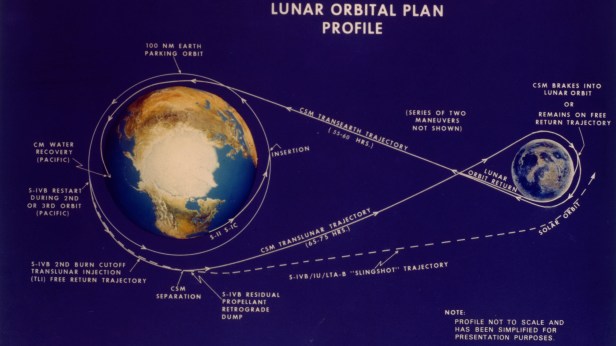
Astronauts Frank Borman, Jim Lovell, and William Anders, the three aboard Apollo 8, were on a mission that had only been approved 4 months prior and required a real scramble for the astronauts to train in the Apollo 8 craft. Two factors caused the sudden change in the meticulously laid-out NASA schedule. First was a delay in the expected delivery of the first Lunar Module, required for landing and needing human testing. Second was a real concern that the Soviets would launch their own deep space Moon mission imminently as they had just sent living creatures, including tortoises, in a path around the Moon and back to Earth. Having the Soviets do the same with cosmonauts would allow them to re-capture public preeminence in the space race.
The space race was borne from public demonstrations that the United States could launch nuclear weapons from home territory and have them land anywhere on Earth it desired. In addition, the race would (theoretically) determine which economic system was superior, Soviet communism versus American capitalism.
But Apollo 8 changed all that – and did so in 1968. By going as far out as the Moon, humans were, for the first time, enabled to perceive the entirety of Earth in a single field of vision. An entire Earth. No human artificial boundaries. No evidence, in fact, of any human activity at all. Little wonder that the picture of Earthrise, taken as the astronauts looked back at their launch point while orbiting the Moon, became an enduring picture of the ages. As Astronaut Anders put it: “We came all this way to explore the moon, and the most important thing is that we discovered the Earth.”
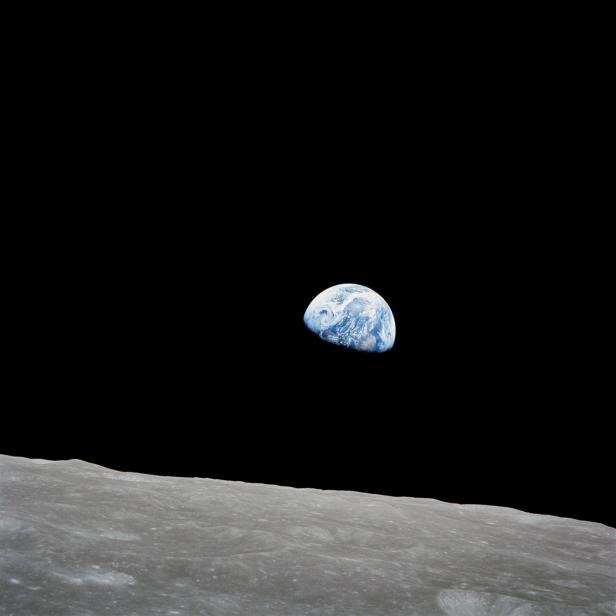
The impact of the Earthrise picture can be credibly argued to be more important than those of American astronauts walking on the Moon. It’s been well over 50 years since our last encounter with the Moon. In the meantime, the Earthrise photo inspired the modern environmental movement and NASA’s Earth science programs, including Landsat.
Apollo 8 ended the framing of NASA as a test of nationalistic capitalism and began the notion of human space exploration. Today, we must remember the forgotten lessons of Apollo. Most importantly, the exploration of space was a national effort, involving all of us. It was not framed around a single, puny human’s childish desire for (alleged) immorality. In fact, an undertaking like Apollo strains the budgets of even an individual nation. That’s why international cooperation will become ever more important as we explore deeper space.
Companies like SpaceX and Blue Origin cannot exist without American taxpayer subsidies and therefore we must not let such entities or their boardrooms believe they are driving the agenda.
NASA’s Administrator who set up the Apollo Program, James Webb, conceived of NASA as a “New Deal” of science and technology. This is why he deliberately spread NASA centers across the country. Multiple companies were involved in major pieces of Apollo and therefore it drew on a broad cross-section of American engineering ingenuity. The Moon project was not created by industrialists or wealthy people. Apollo, and the scientific knowledge and human wonder it generated, was a decisively American achievement.
Most importantly: there is no obvious inherent business model for profit in space. NASA products like Landsat photos were taken and archived for the benefit all Americans, including farmers and city planners, since they were paid for by tax dollars. Areal Google maps are courtesy of NASA photography, again paid for by citizen tax dollars. NASA has no need for a business person helming it – because NASA does not represent a business need.
Money is not an adequate metric for measuring NASA’s worth. The return on investment of the Apollo program is the priceless awareness of ourselves found in the photo Earthrise taken on Christmas Eve 1968. That nuanced awe must never be lost if space exploration is to matter at all.

 Thoughts and Thinks